Netrights: Internet Access as a Human Right
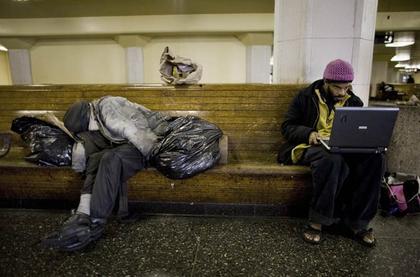
Now the Boing Boing poster made a prediction, that within 5 years the UN will deem network access a "basic human right." This idea intrigues me for several reasons. First of all, I was not aware that the UN deemed anything "nonessential" as a human right, but things such as free speech, education, and privacy are considered human rights. It also made me think about the Internet and how it has become a huge part of our lives. We do our banking online, pay our bills, look for work, talk to friends and family, download music and videos, get the latest news, and even watch TV. It's become so ingrained into the fabric of society, that not having access to it for any prolonged period would be devastating; the modern day equivalent of solitary confinement.
It's true that at a basic level, nobody needs Internet access (or a computer, or an iPhone, or anything like that) to survive. Food, water, shelter; those are survival essentials and rightfully are basic human rights. But humans are not just about survival. We're about collaborating, communicating, creating, conducting commerce, and other words that seem to start with "c". We've been doing this for thousands of years, just never with such a wealth of information so easily available, or communication so fast and widespread. Information is power, and with so much information freely available it means that almost anyone can connect and learn and grow.
I find the fact that a homeless man in New York can talk to a university professor in Los Angeles, or a lawyer in London, or a writer in Buenos Aries (setting aside language barriers of course) to be one of the most amazing things about the net. Sure they might be talking about their favorite LOL Cat, or just Tweeting what kind of sandwich they're currently enjoying, but in the past there was no way for you to talk to anyone outside a small circle of friends and acquaintances. Radio and television allowed almost instance communication to the masses and the telephone allowed live conversation to take place across the world, but those communication systems are either limited in scope or exclusive, and the net levels the playing field considerably. When you are online, you are the same as everyone else. You can have a blog, you can post in a forum, you can display your art, you can apply for a job, you can research a paper; the possibilities are endless. And none of it is closed off to you because you live in a shelter, or you don't wear the right clothes, or have the right number of 0's at the end of your paycheck.
I don't think it will happen in 5 years. I hope it does, because the rise of the netbook and the success of programs like One Laptop Per Child have made it clear that access to something that is fast becoming a fundamental part of modern society should be available to all. And I agree with the poster on Boing Boing, one day we will look back and wonder how we ever thought that it wasn't a fundamental right of every human being. So what do you think?


4 comments:
You could make the argument that this is already pretty well covered in Article 27, Section 1 of the UN's Universal Declaration of Human Rights:
"Everyone has the right freely to participate in the cultural life of the community, to enjoy the arts and to share in scientific advancement and its benefits."
In the US, at least, this is pretty well implemented by the library system. Anyone with a library card can use an Internet-connected PC for at least an hour a day (more at larger branches).
Library cards are free, and while you need proof of address for a full-service card (which might be difficult for the homeless, although many shelters will allow residents to use them as their legal address), you can get a limited card that allows five items out at a time and full computer privileges without providing proof of address.
I think this is a really interesting idea - the internet as a basic right - but I also think that we are way too early as a nation, as a society for this.
In our crowd of technologically informed, relatively hip, college-educated, white, lower-middle-class to middle-class group we've become rather insulated because the majority of our discourse is with like-minded people with similar resources.
However there actually are lots of people out there who have no computer and no burning desire for one. They don't use the internet, they do everything via phone or the mail. They use a computer at work, and that's it. I know several of these people, and they are happy without the internet. Is that me? No.
My opinion is that we need to give people access to the actual tools necessary for survival before giving them Myspace. I think that we should focus on stopping worldwide poverty, starvation, violence, genocide - providing people with the security and resources necessary to live their lives - before we start approaching the internet as a basic human right.
I agree that the internet has an amazing ability to bring vastly different people together. People across the globe can affect each other in ways never before possible, and that's an awesome thing.
But giving someone access to a laptop doesn't do a whole lot if they can't feed their family that day.
I don't think anyone's campaigning for internet access to take priority over elements necessary for survival (or be foisted upon those who see no need for it), but pointing out that it's a vital force in the world today.
To me, internet access rights means "right to knowledge". Not that everyone fires up Chrome to research medical journals, but the potential for education is always there. Or, perhaps more importantly, internet provides access to information about our government.
Internet censorship is a very real thing, maybe not so much in the US, but even Australia has very restrictive policies.
I don't know what changes would be actuated if internet access were to be deemed a human right, but fewer restrictions on access to knowledge seems like a good idea to me.
The beauty of the internet is that anyone can make anything widely available; to me, this is so integral to keeping the higher powers in check and defending what are currently acknowledged a basic human rights. Eh, I'll save the conspiracy theories for another time ;)
Nice post, Mike, you got me thinking!
@Movie Meg - Thanks! And you nailed the point of the post/article. This is not about forcing people to have a computer or smart phone to be a part of society. Granting someone a right means that the opportunity is available to them to take advantage of that right if they so choose, not saying "everyone will have this, even if they don't want it!" It also means that their ability to exercise that right is protected. Thus granting internet access human right status means that while not everyone will want the ability to use the internet, no one can be DENIED that ability either. It protects people from censorship, or being refused access because of their race, gender, or political affiliations.
Post a Comment